Moon Sweepers Progression Guide: Stearns Road Contracts and Surface Exploration
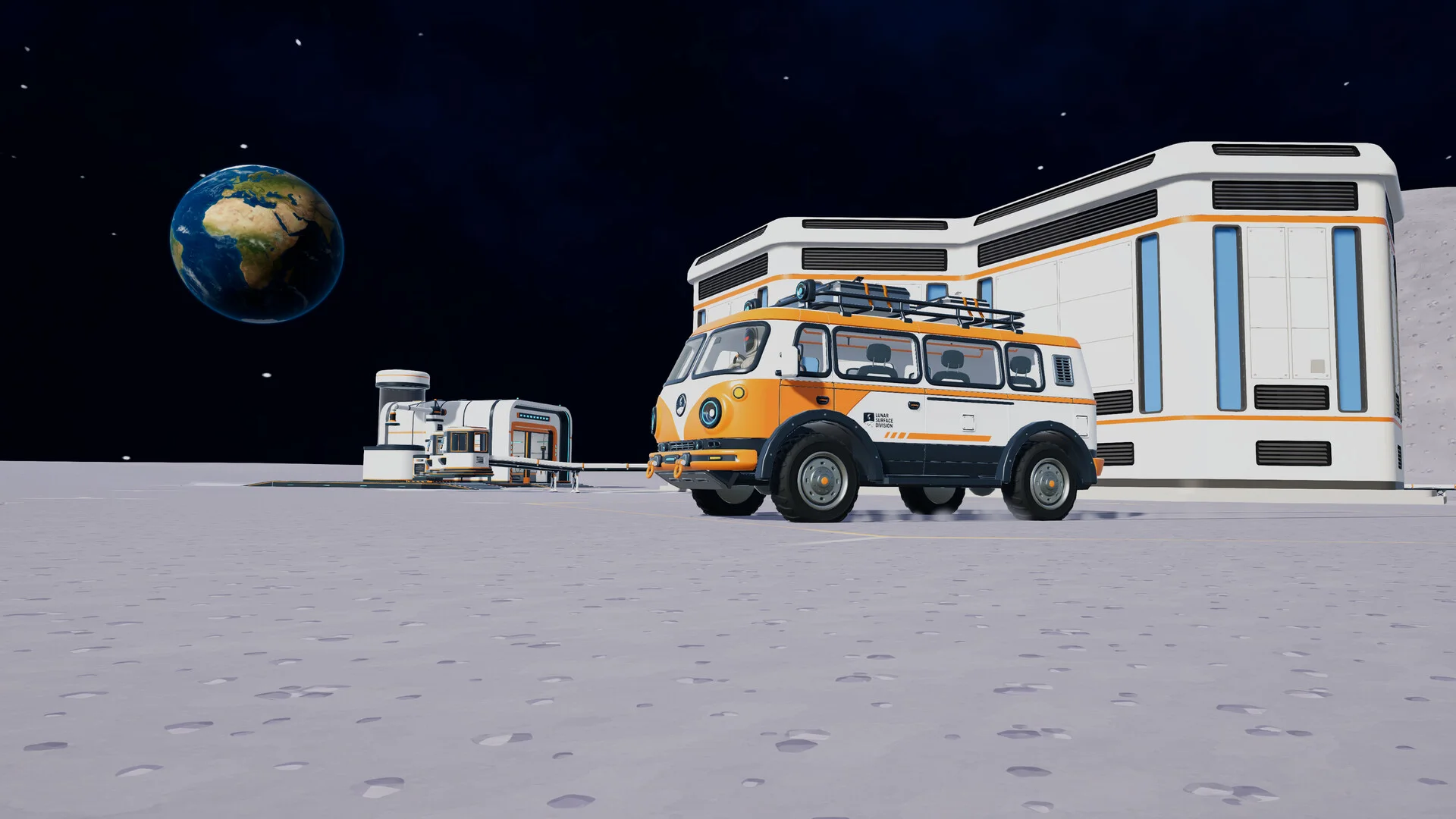
Long-range progression in Moon Sweepers centers on maximizing commercial dust contracts, maintaining transit arteries like Stearns Road, and uncovering historic Apollo landing sites across 163,000 sectors.
Contract Scaling and Lunar Dust Economy
Early cleaning profits grow significantly as operatives invest in economic research branches at the base terminal. Upgrading commercial agreements transforms routine regolith extraction into a lucrative enterprise through several core perks:
 Market Contracts: Purchasing the initial Tier 1 contract upgrade for $120 yields an immediate +6% payout increase on all sold regolith. Advancing to Tier 3 unlocks a +18% launch payout bonus, substantially elevating earnings per kilogram dumped into the silo.
 Supplier Network: Lowers the capital cost required to purchase advanced tools and container modifications across three successive discount tiers.
 Region Bounty: Awards a cash bonus upon completely cleaning every hexagonal cell within an entire mapped region. Tier 1 grants an extra $15 per region, Tier 2 elevates the bounty by $30, and Tier 3 maxes the payout at $40 per cleared region.
 Lunar Exchange: Grants operatives direct access to premium market trading channels, guaranteeing top payouts for every outbound rocket launch.
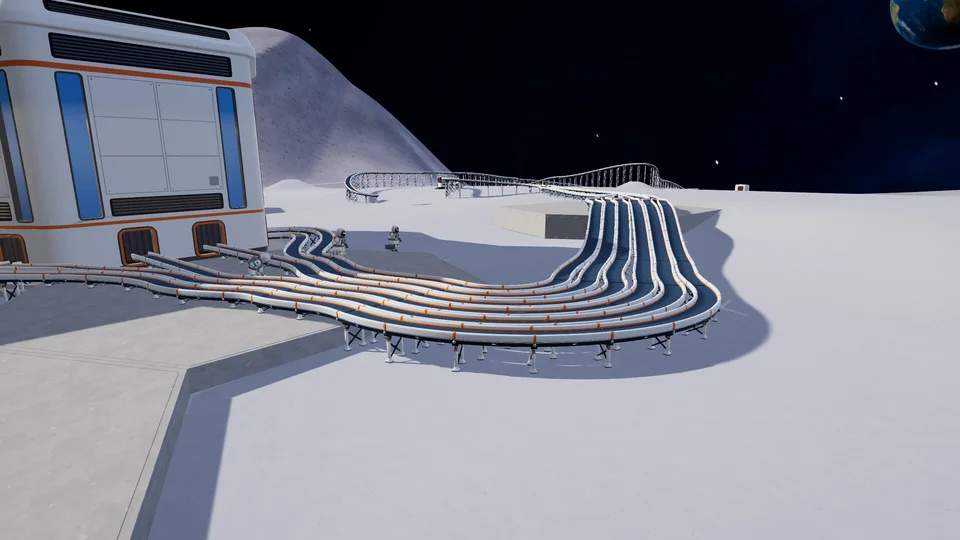
Transit Routes and Stearns Road Logistics
As operations expand outward from the initial station perimeter, establishing durable transit arteries becomes vital. Stearns Road serves as a crucial transit highway connecting central industrial facilities with outlying mining sectors. Left unmaintained, drifting dust deposits impede wheeled rover traffic and degrade driving efficiency.
Using the  Building tool, crews can construct elevated pedestrian walkways like the
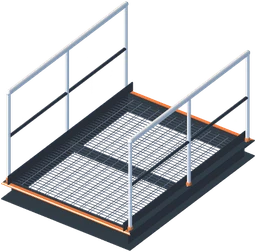 Catwalk - 2 m and
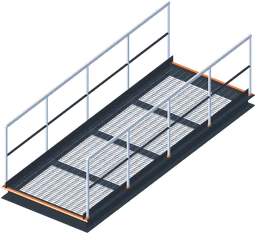 Catwalk - 4 m over jagged craters. For ferrying crew members across long-distance highways such as Stearns Road, deploy the
 Crew transport. Capable of cruising at 6.0 m/s with an enclosed pressurized cabin and 400 kg cargo volume, it provides safe multi-operative transit past hazardous terrain.

Historic Lunar Sites and Flag Cataloging
Scattered across the lunar surface lie historic space exploration landmarks and 195 commemorative national flag sites. Operatives can survey and clear regolith surrounding these protected historical coordinates:
| Landmark | Mission Details | Lunar Coordinates |
|---|---|---|
 Apollo 11 |
First crewed landing site of Neil Armstrong and Buzz Aldrin | 0.67 Lat, 23.47 Lon |
 Apollo 12 |
Landed within walking distance of the robotic Surveyor 3 probe | -3.01 Lat, -23.42 Lon |
 Apollo 14 |
Fra Mauro highlands exploration site where golf balls were struck | -3.65 Lat, -17.47 Lon |
 Apollo 15 |
Hadley-Apennine site where the first Lunar Roving Vehicle drove 28 km | 25.91 Lat, 3.78 Lon |
 Apollo 16 |
Descartes Highlands scientific survey and rover expedition | -8.97 Lat, 15.5 Lon |
 Apollo 17 |
Taurus-Littrow valley landing of Gene Cernan and Harrison Schmitt | 20.19 Lat, 30.77 Lon |
Restoring these historical zones provides dedicated mission achievements and valuable regional progress toward clearing the entire planetary surface.
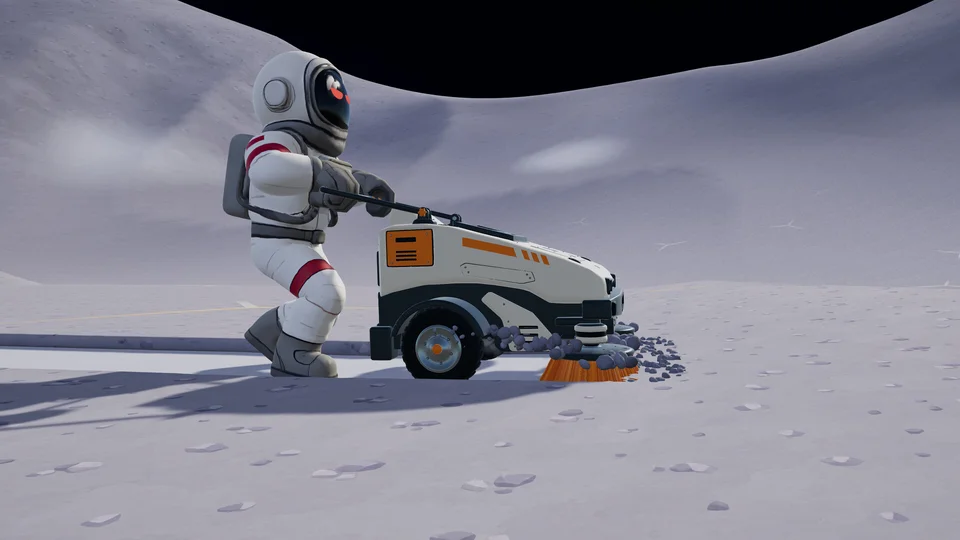
Sector Completion and Exploration Loadouts
Surviving deep expeditions beyond Stearns Road requires tailored personal equipment. Equip  Night Vision Goggles and an upgraded
 Helmet Lamp to spot regolith boundaries during prolonged lunar darkness. Install
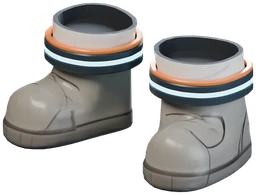 Gravity Boots to prevent drifting when navigating steep crater rims, and utilize the
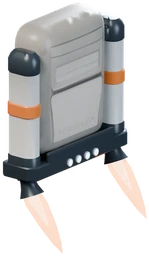 Forward Jetpack to leap over jagged fissures without building elaborate detour bridges.
For early sweeping basics and manual brush ratings, consult our foundational beginner guide. To review mechanized rover specifications and automated unloading stations, read our comprehensive sweeper vehicles and upgrades guide. Complete landmark coordinates and historical notes are available in the Landmarks Database.